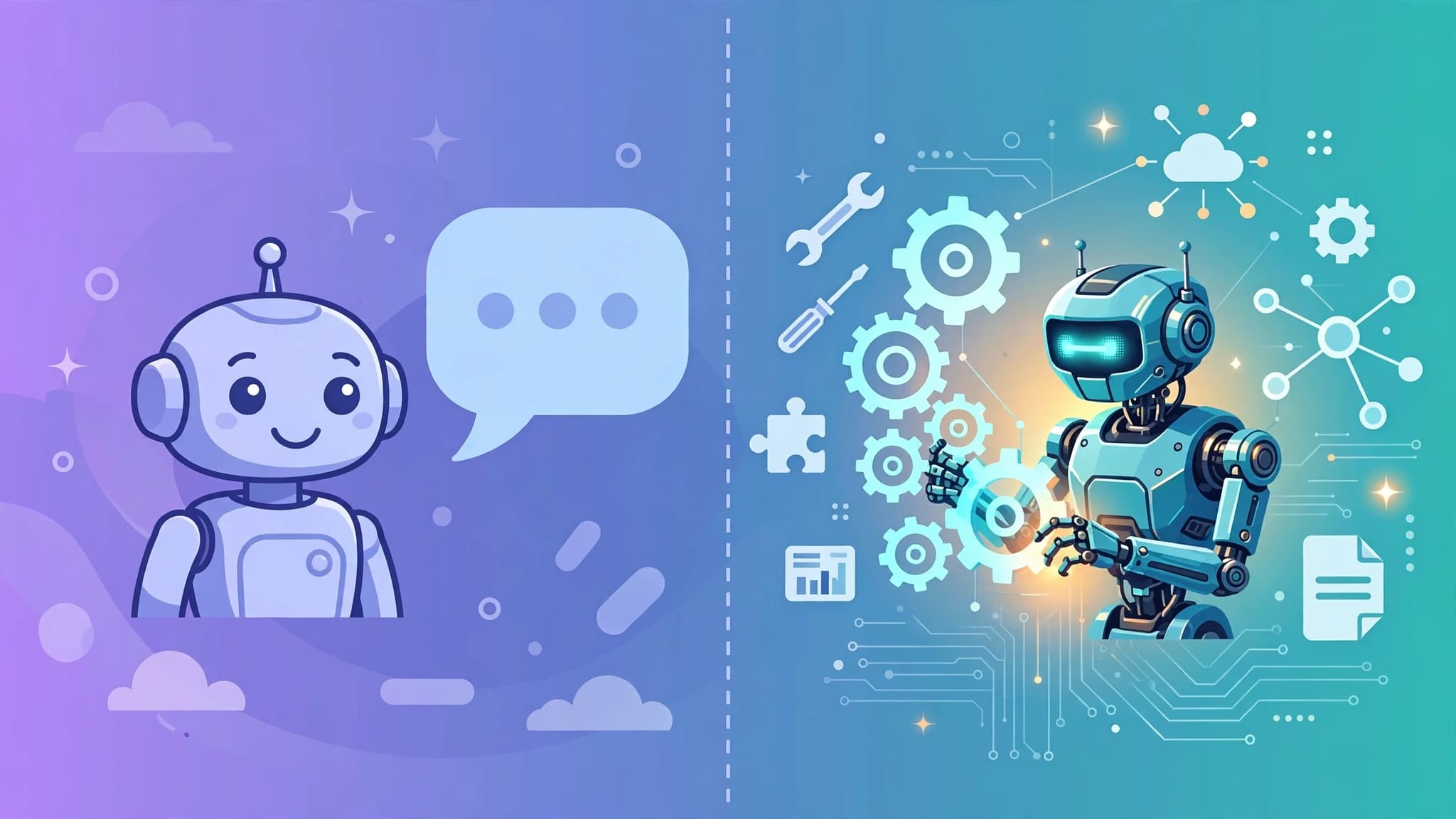
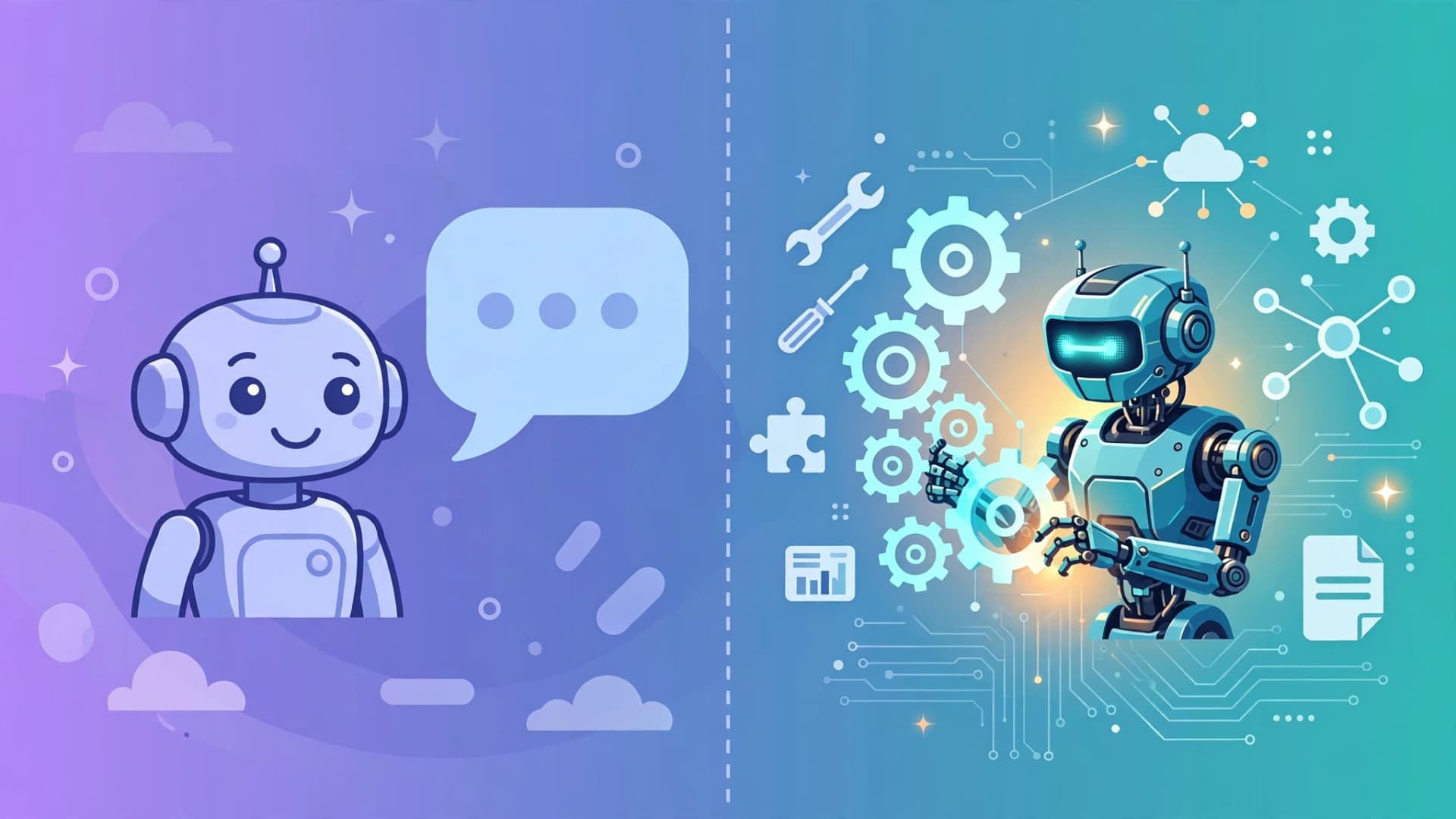
If you only talk to it, it is a chatbot. If it decides what to do next and takes action across your tools, it is an AI agent. That single sentence settles 80% of the debate. The remaining 20% is what costs teams real money, so here is a practical decision guide for picking the right one in 2026.
The 90-second decision test
Ask yourself one question about each task you want to automate: does the job end with a reply, or with a result?
- Ends with a reply ("What is your return policy?", "How do I reset my password?") → chatbot.
- Ends with a result (refund issued, appointment booked, CRM updated, ticket resolved) → AI agent.
This framing, echoed across recent 2026 comparisons, is the most reliable shortcut. Chatbots respond; agents act. A chatbot answers the return-policy question; an agent checks the order, verifies eligibility, initiates the refund, and confirms the outcome. Most teams in 2026 start with a chatbot and graduate to agents as complexity grows.
Quick comparison
| Dimension | Chatbot | AI agent |
|---|---|---|
| Core job | Answers questions | Completes tasks |
| Behaviour | Reactive: picks the best answer | Proactive: plans steps, calls tools |
| Action capability | None — hands off to a human | Calls APIs, updates databases, triggers integrations |
| Memory | Current session, a few turns | Cross-session history and context |
| Setup effort | Low: connect a knowledge base, deploy a widget | Medium: API access, workflow mapping, guardrails, testing |
| Best for | FAQs, first-line support, lead capture | Refunds, bookings, sales automation, internal ops |
| Typical SaaS cost | Free to about $39/mo | Free tiers exist; paid plans from roughly $10–$49/mo |
When a chatbot is the right call
Choose a chatbot when the work is genuinely conversational and the output is information, not an action. Five scenarios where chatbots still win outright:
1. High-volume FAQs. If visitors ask the same forty questions — pricing, hours, shipping, delivery times — a chatbot connected to your knowledge base deflects those instantly. A rule-based or AI-powered bot can launch in an afternoon, and on pure FAQ work it remains cheaper and more predictable than an agent.
2. Exploratory conversations. When the user does not yet know what they are asking, a conversational loop beats autonomous execution. Brainstorming, hypothesis generation, and ad-hoc data interpretation all benefit from back-and-forth where human judgement shapes each step.
3. Lead capture and routing. "Which plan fits a team of five?" followed by a booking link or a handoff to sales. Chatbots collect the details, qualify lightly, and route — no tool-calling required.
4. Tight budgets with immediate needs. Several solid platforms offer free tiers. Chatbase lets you build a self-service knowledge-base bot with no-code setup, starting free with paid plans from $32/mo. ChatBot.com offers template-driven bots from $19/mo. If your need is answers, paying agent prices for an answer engine is wasted money.
5. Compliance-sensitive answers. Where answers must be verbatim and predictable — legal disclaimers, regulated product information — a tightly scoped chatbot is easier to audit than an autonomous agent.
When an AI agent is the right call
Choose an agent when the request only counts as handled if something changes in a real system. The hallmarks: multi-step work, repeatable tasks, and defined completion criteria.
1. Refunds, bookings, and rescheduling. The canonical agent demo: a customer says "I want to return my order," and the agent checks the order, verifies the 30-day policy, issues the refund, and confirms. A chatbot can quote the policy; only an agent can close the loop.
2. Sales automation and lead qualification. Agents research a lead across enrichment tools, score them, write a personalised follow-up, and log it in the CRM. No-code platforms such as Lindy specialise in exactly these AI-native assistant workflows around email, calendars, and meetings.
3. Internal operations and reporting. Weekly competitive monitoring, data quality audits, stakeholder report generation — tasks with known inputs, known structures, and known completion states. These are precisely the conditions under which autonomous execution outperforms a guided conversation, and the savings compound because the task repeats.
4. Multi-system lookups. "Where is my order?" answered properly may need the order system, the warehouse, and the courier's tracking API stitched together. Agents chain tool calls; chatbots read from one knowledge base.
5. Research and enrichment pipelines. Visual builders like Gumloop lead for data-heavy agent workflows — scraping, enrichment, and processing — that a chatbot simply cannot perform.
The data point worth knowing
A recent analysis of 680,000+ Taobao support chats found that chats handled by Alibaba's agent finished 16.8% faster, outcomes did not improve, and satisfaction fell 0.41 points on a five-point scale. Agents are not a straight upgrade. They win on resolution of multi-step work, not on every metric — which is exactly why the decision test matters more than the hype.
What each one actually costs
Costs in 2026 split across two tracks: SaaS products and custom builds.
Chatbot SaaS: free tiers from Chatbase and Botpress (Botpress runs a free pay-as-you-go model with $5 of AI credit per month), paid plans roughly $19–$39/mo (ChatBot.com from $19/mo, Chatbase from $32/mo, LiveChatAI from $39/mo). For most small teams, that is the entire bill.
AI agent builders: Taskade offers a free plan with 6,000 starting credits and paid from $10/mo; n8n's community edition is free and unlimited when self-hosted; Flowise is Apache 2.0 licensed and free to self-host; Zapier Agents, Relay.app, and StackAI offer free tiers with monthly credit limits. Entry paid plans run roughly $9–$39/mo, plus LLM API fees on top.
Custom builds: published 2026 estimates put an advanced AI-powered chatbot at $10,000–$25,000, while a full AI agent system runs $15,000–$150,000+. The premium comes from tool integrations, workflow logic, failure handling, and scalability design — not from "smarter" answers. Per-task pricing compounds fast at scale, so flat per-seat or self-hosted pricing is more predictable for production agents.
Start here: the cheapest way to try each
If you want to feel the difference before spending anything:
- Try a chatbot: build a free knowledge-base bot with Chatbase or Botpress. Connect a help-centre or a few pages of documentation, deploy the widget, and watch it answer real questions. Total time: an afternoon.
- Try an agent: self-host n8n's community edition for free, or take Taskade's free plan. Give the agent one bounded, repeatable task with a defined output — for example, "monitor this inbox and draft a summary report every morning" — and let it call tools. Total time: a weekend.
The pattern most teams land on: a chatbot as the front door that answers and qualifies, handing off to agents for the tasks that require action. You do not have to pick one forever.
The guardrail rule nobody skips
One failure mode deserves a blunt warning. Agents that operate without sufficient guardrails complete tasks confidently and incorrectly. A chatbot that misunderstands a prompt produces a bad response that a human immediately sees and corrects. An agent that misunderstands a goal produces a polished, well-formatted artefact that is wrong in ways that are harder to catch. Autonomous execution amplifies both good and bad inputs.
Before any agent touches production data: define the goal precisely, specify the output format, build validation logic, and test edge cases. A chatbot you can use in five minutes; a well-built agent pipeline takes days to design and test properly. For one-off tasks, that investment does not pay off. For tasks that run weekly or daily, it compounds quickly.
Key takeaways
- Chatbots answer questions; AI agents complete tasks. If the job ends with a reply, buy a chatbot. If it ends with a result, build an agent.
- Chatbots win on speed to launch, predictable answers, and cost for high-volume FAQ work — free to ~$39/mo covers most small teams.
- Agents win on multi-step, repeatable work that touches real systems — refunds, bookings, lead qualification, reporting — starting from free self-hosted options like n8n and Flowise.
- Field data shows agents are not a universal upgrade: faster resolution, but no outcome improvement and slightly lower satisfaction in one large support study.
- Never give an agent production access without guardrails: autonomous execution amplifies bad inputs into polished, hard-to-catch mistakes.