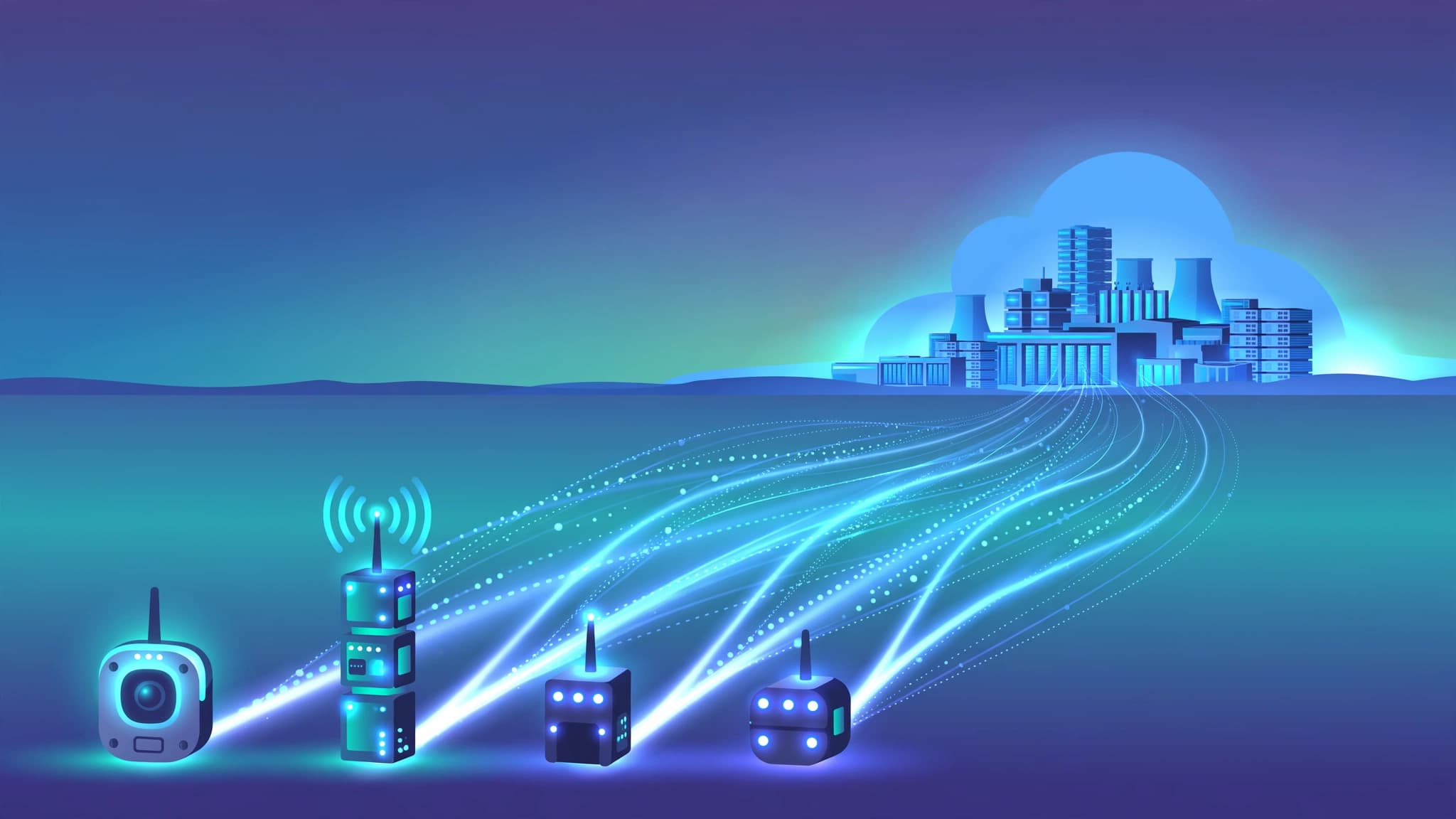
Every smart camera, connected factory, and voice assistant raises the same infrastructure question: where should the data actually be processed? For years the default answer was "the cloud". In 2026, the answer is less automatic. Edge computing — processing data close to where it is created — has grown into a genuine alternative, with the edge computing market reaching roughly USD 257 billion in 2026 according to industry analysts. This guide breaks down what each approach is, where they differ, and how to choose between them.
What is cloud computing?
Cloud computing delivers storage and computing power over the internet from centralised data centres. Instead of running your own servers, you rent virtual machines, databases, and services from providers like Amazon Web Services (AWS), Microsoft Azure, or Google Cloud Platform.
The model is deliberately simple: your application sends data to a faraway data centre, the cloud does the heavy work, and the result comes back. Because the provider pools enormous hardware, you can scale from a single server to thousands in minutes and pay only for what you use. Cloud computing shines at big data analytics, SaaS platforms, machine learning training, streaming services, and anything that needs massive centralised storage and compute.
The trade-offs are distance and dependency. Every round trip travels to the data centre and back, which adds latency. If the internet connection drops, so does your application. And sensitive data has to leave your premises, which is not acceptable in every industry.
What is edge computing?
Edge computing moves the processing to the "edge" of the network — on or near the devices that generate the data. That might be a sensor gateway on a factory floor, a computer inside an autonomous vehicle, or a micro data centre attached to a 5G base station.
The principle is straightforward: analyse the data where it is born, send only the useful results back to the cloud. A security camera can detect motion locally and upload a 10-second clip instead of a 24-hour video stream. A production line can spot a defect in milliseconds and stop the machine before more units are ruined.
Key edge use cases in 2026 include autonomous vehicles, smart factories and industrial automation, healthcare wearables, smart-city traffic systems, and AR/VR headsets. The standalone 5G roll-out has accelerated things further: Asian operators had installed about 1.8 million edge-enabled 5G sites by mid-2025, pushing round-trip latency below 10 milliseconds for nearby workloads.
Edge computing vs cloud: the key differences
| Aspect | Cloud computing | Edge computing |
|---|---|---|
| Processing location | Centralised data centres | Near the data source (devices, local nodes) |
| Latency | Higher — data travels over the network | Very low — processed locally |
| Bandwidth usage | High — raw data is uploaded | Low — only results are sent back |
| Scalability | Virtually unlimited, elastic | Limited by local hardware |
| Offline capability | Needs constant connectivity | Can keep working with intermittent or no connectivity |
| Data privacy | Data leaves your environment | Sensitive data can stay local |
| Upfront cost | Low — pay-as-you-go | Higher — local hardware required |
| Management | Centralised, handled by provider | Distributed fleet of devices to maintain |
Latency: the deciding factor
Latency is the difference that matters most. A cloud round trip typically takes tens to hundreds of milliseconds; an edge node can respond in single-digit milliseconds. For most web apps, nobody notices. For a self-driving car deciding whether to brake, or a machine-vision system rejecting defective parts on a conveyor belt, those milliseconds are the whole product.
This is why industrial edge adoption keeps climbing. Research shared by Stratus Technologies projected edge workloads in industrial environments growing up to 46% through 2026. Smart-manufacturing pilots show the payoff concretely: in one well-known testbed, relocating analytics from the cloud to the edge cut a 15-second control loop to roughly 40 milliseconds.
Bandwidth and cost
Raw sensor data is heavy. Millions of factory sensors streaming telemetry to the cloud would saturate network links and rack up egress bills. Edge nodes filter and aggregate locally — sending one alert instead of one hour of footage. That cuts bandwidth costs and energy use at the same time.
The flip side: edge hardware costs real money up front, and you have to install, secure, and maintain dozens or hundreds of devices instead of one central deployment. Market research consistently names high capital investment as the main restraint on edge adoption, especially for smaller companies. Cloud's pay-as-you-go model still wins for anything that can tolerate the round trip.
Security and privacy
Neither approach is automatically more secure. Edge computing keeps sensitive data local, which helps with regulations that restrict cross-border data transfer and with applications like patient monitoring where footage should never leave the building. But each edge device is a new physical endpoint to secure and patch.
Cloud providers invest more in security than almost any individual company could, with audited compliance certifications — but your data sits on someone else's servers, travelling over networks you don't control. In practice, the strongest setups combine both: sensitive processing at the edge, encrypted results and archives in the cloud.
What about fog computing?
You will occasionally see "fog computing" mentioned alongside edge and cloud. Fog is simply the middle layer: computing, storage, and networking distributed across nodes between the edge devices and the central cloud — think local servers in a telco exchange or a factory's own mini data centre. It balances the workload, reducing latency without pushing everything to tiny edge devices. For most practical decisions, the edge-vs-cloud framing covers what you need; fog is just the hybrid architecture between them.
When to use cloud computing
- You need massive, elastic compute or storage
- The workload is not latency-sensitive (analytics, backups, batch jobs)
- You want global access and centralised management
- You prefer low upfront cost and pay-as-you-go pricing
- You are building web apps, SaaS, or enterprise platforms
Typical examples: e-commerce platforms, media streaming, CRM systems, machine-learning model training, and big data analytics.
When to use edge computing
- You need real-time or near-instant responses
- Connectivity is limited, unreliable, or expensive
- You want to cut bandwidth costs
- You are working with IoT sensors, cameras, or industrial equipment
- Privacy or regulation requires data to stay local
Typical examples: autonomous vehicles and drones, predictive maintenance, real-time healthcare monitoring, smart-city infrastructure, and retail personalisation at the shelf.
The real answer: hybrid is the norm
Very few organisations choose one and drop the other. The dominant 2026 pattern is hybrid: edge handles the time-critical filtering and decisions, the cloud handles long-term storage, model training, fleet-wide analytics, and dashboards. Your factory floor runs inference on edge nodes; the aggregated insights train the next model version in the cloud; the updated model is pushed back out to the edge.
The edge services market itself reflects this: analysts at Omdia forecast edge computing services revenue reaching USD 214 billion by 2026, driven largely by managed, cloud-delivered edge services — the hyperscalers extending their platforms outward rather than being replaced.
If you are planning infrastructure this year, start from the workload, not the buzzword. Ask: how much latency can we tolerate, how much data can we afford to move, and where must the data legally stay? The answers will tell you whether the processing belongs in a data centre — or at the edge.
Key takeaways
- Cloud computing centralises processing in remote data centres; edge computing processes data near its source for minimal latency.
- Latency is the main differentiator: edge enables single-digit millisecond responses, cloud adds network round-trip delay.
- Edge cuts bandwidth costs and keeps sensitive data local, but needs more upfront hardware investment and device management.
- Cloud wins on scalability, global access, and low upfront cost — the best choice for analytics, SaaS, and storage-heavy workloads.
- In 2026 the dominant pattern is hybrid: real-time processing at the edge, training, storage, and fleet analytics in the cloud.