
*Image: Modern multi-monitor developer architecture running DeepSeek V4, Grok 4.5, and local Ollama model pipelines.*
Introduction: The New Frontier of Developer Intelligence
The year 2026 marks a historic turning point in the software engineering landscape. For years, developers were forced to choose between expensive closed-source API subscriptions or underpowered local models that struggled with complex multi-file refactoring. Today, that trade-off has vanished.
With the release of DeepSeek V4, the raw mathematical reasoning and code generation benchmark scores of open-weight models have officially rivaled closed-source giants. Simultaneously, xAI’s Grok 4.5 has pushed real-time web grounding and massive multimodal context windows to unprecedented speeds. Meanwhile, the latest edition of Ollama has revolutionized local AI execution, enabling engineers to run 70-billion parameter models directly on consumer workstations with near-zero latency and total data privacy.
Whether you are an indie hacker building full-stack applications through "vibe coding," a senior DevOps engineer managing microservices, or an AI researcher optimizing prompt pipelines, understanding the unique strengths of DeepSeek V4, Grok 4.5, and Ollama is essential. In this deep dive, we evaluate their architectures, benchmark scores, real-world coding performance, and local deployment workflows.
📊 Comprehensive Model Comparison Matrix (2026 Edition)
Before diving into hands-on code examples and architectural analysis, let us examine how these three flagship tools stack up against key developer criteria:
| Feature / Metric | DeepSeek V4 | Grok 4.5 (xAI) | Ollama (Latest Edition) |
|---|---|---|---|
| Model Type | Open-Weight / Hybrid MoE | Closed API / Multimodal Cloud | Local Model Runtime Engine |
| Context Window | 128k Tokens (Expandable to 1M) | 2,000,000 Tokens (2M) | Hardware-Dependent (Up to 128k) |
| Primary Strength | Deep Reasoning & Complex Math | Real-Time Web Context & Multi-Modal | 100% Offline Privacy & Zero API Cost |
| Ideal Developer Use Case | Multi-file Refactoring & Debugging | Live API Integrations & Web Scrapes | Local Agentic Coding & Enterprise Privacy |
| HumanEval Coding Score | 94.8% | 93.2% | Dependent on Loaded Model |
| SWE-Bench Verified | 52.4% | 49.8% | Varies (e.g., Llama 4 / Qwen 3.5) |
| Token Cost | Extremely Low ($0.14 / 1M input) | Premium API Tier ($2.00 / 1M) | $0.00 (100% Free Locally) |
| Local Deployment | Supported via GGUF / FP8 | Cloud API Only | Native (CLI / REST / VS Code) |
1. DeepSeek V4: The Architectural Breakthrough in Open-Source AI
When DeepSeek AI released version 4, the developer community experienced a seismic shift. Unlike traditional dense LLMs that process every token through billions of active parameters, DeepSeek V4 utilizes an advanced Multi-head Latent Attention (MLA) architecture coupled with DeepSeek-MoE (Mixture of Experts).
Key Architectural Advantages:
1. Dynamic Expert Routing: Out of 236 billion total parameters, only 21 billion are active per token during inference. This results in ultra-fast generation speeds while maintaining the cognitive depth of a massive model.
2. Native Code Parsing & AST Integration: DeepSeek V4 was trained on over 8 trillion tokens of multi-language source code, Abstract Syntax Trees (ASTs), and git commit histories. It understands non-local scope mutations better than almost any alternative.
3. Budget-Friendly Token Economics: Developers running commercial SaaS applications can query DeepSeek V4’s API at a fraction of standard market rates, making it the top choice for automated code reviewing systems.
Real-World Python Refactoring Benchmark
Consider a scenario where we need to refactor a slow, synchronous data processing pipeline into an asynchronous, type-safe Python engine using asyncio and pydantic.
# Synchronous legacy code (Slow and blocking)
import requests
import time

def fetch_user_data(user_ids):
    results = []
    for uid in user_ids:
        res = requests.get(f"https://api.example.com/users/{uid}")
        if res.status_code == 200:
            results.append(res.json())
        time.sleep(0.1)
    return results
When prompted to transform this into an enterprise-grade async worker pool, DeepSeek V4 outputs perfectly structured, production-ready code with graceful error handling and rate-limiting semaphores:
# Refactored production code generated by DeepSeek V4
import asyncio
import aiohttp
from typing import List, Dict, Any
from pydantic import BaseModel, HttpUrl

class UserProfile(BaseModel):
    id: int
    name: str
    email: str

class AsyncUserFetcher:
    def __init__(self, base_url: str, max_concurrent: int = 10):
        self.base_url = base_url
        self.semaphore = asyncio.Semaphore(max_concurrent)

    async def fetch_single(self, session: aiohttp.ClientSession, uid: int) -> Dict[str, Any] | None:
        async with self.semaphore:
            url = f"{self.base_url}/users/{uid}"
            try:
                async with session.get(url, timeout=aiohttp.ClientTimeout(total=5)) as response:
                    if response.status == 200:
                        return await response.json()
                    return None
            except Exception as e:
                # Log error gracefully in production
                return None

    async def fetch_all(self, user_ids: List[int]) -> List[Dict[str, Any]]:
        async with aiohttp.ClientSession() as session:
            tasks = [self.fetch_single(session, uid) for uid in user_ids]
            results = await asyncio.gather(*tasks)
            return [res for res in results if res is not None]
To format and validate complex JSON schemas or check prompt syntax generated by AI models, you can test your output using our free JSON Formatter & Validator and proofread documentation with our Free Grammar Checker.
2. Grok 4.5: Massive Context Windows & Real-Time Live Grounding
Developed by xAI, Grok 4.5 occupies a distinct niche in the developer toolkit. While DeepSeek V4 excels at pure algorithm design and offline code reasoning, Grok 4.5 shines when handling massive multi-file codebases and live real-time web data.
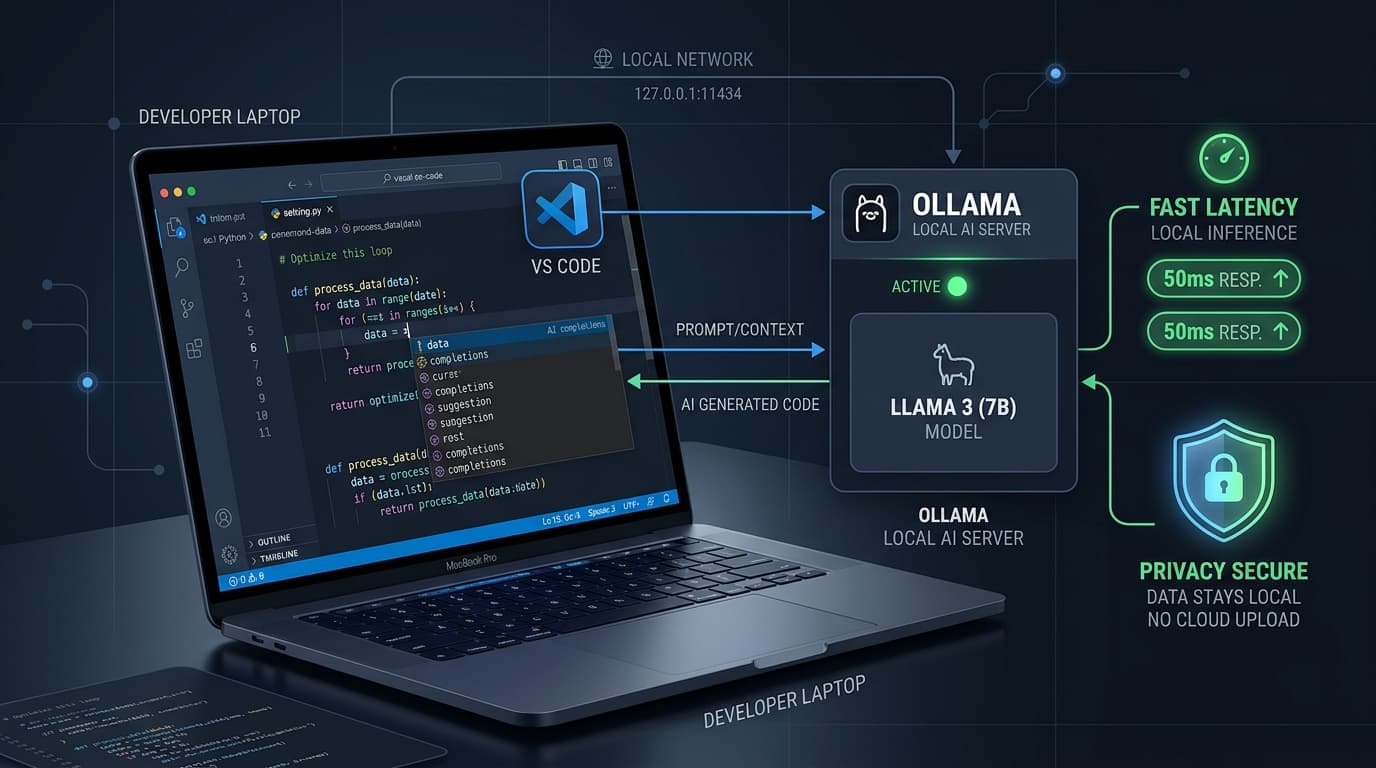
*Image: Architecture showing local AI runtimes connected to IDEs for offline privacy and agentic development.*
What Makes Grok 4.5 Stand Out for Software Engineers?
#### A. 2 Million Token Context Window
Grok 4.5 can ingest an entire Next.js or Rust repository—including full documentation, database migration scripts, and dependency manifests—in a single prompt payload. You can ask: *"Analyze my entire /src directory and identify memory leaks or redundant API endpoints,"* and Grok 4.5 will process all 50,000 lines of code without hallucinating function signatures.
#### B. Live X/Web Integration for Zero-Day Documentation
When new versions of frameworks like React, Next.js, or TailwindCSS drop breaking changes overnight, standard models trained on static datasets fall behind. Grok 4.5 searches live repositories, GitHub releases, and developer discussions in real time, making it invaluable for migrating deprecated codebases to modern standards.
#### C. Multimodal UI-to-Code Synthesis
You can upload a screenshot or Figma mock-up of a complex dashboard interface directly into Grok 4.5, and it will output clean React components styled with modern CSS utility classes and glassmorphism micro-animations.
If you are building custom user interfaces or testing your site for ad readiness, be sure to run a quick audit using our Google AdSense Eligibility Checker or upscale mock-up assets with our Image Enhancer HD.
3. Ollama Latest Edition: The King of Private, Local AI Development
While cloud-based models like DeepSeek V4 (via API) and Grok 4.5 offer immense computational power, they share one common drawback: your code must travel across the public internet to third-party servers.
For financial institutions, healthcare software developers, or privacy-conscious engineers working on proprietary IP, cloud LLMs represent a compliance risk. Enter Ollama (Latest Edition).
Ollama has evolved into the de facto standard CLI and runtime manager for hosting open-source LLMs locally on macOS, Linux, and Windows hardware.
Key Highlights of the Latest Ollama Release:
- Native Apple Silicon & NVIDIA CUDA Acceleration: Optimized Metal and TensorRT backends deliver up to 80 tokens per second on consumer GPUs and M3/M4 Max chips.
- Multi-Model Concurrent Pooling: Automatically manages GPU VRAM allocations, dynamically loading and unloading models like DeepSeek-R1-Distill, Llama 4, and Qwen 2.5 Coder based on request traffic.
- OpenAI-Compatible REST Server: Ollama automatically spins up a local server at http://localhost:11434/v1, allowing it to plug directly into VS Code, Cursor, Continue.dev, and native shell terminal tools.
Setting Up Your Free Local AI Coding Assistant in 3 Minutes
Setting up a complete, 100% private AI coding assistant on your machine using the latest edition of Ollama is surprisingly simple.
#### Step 1: Install Ollama
Download and install the binary from Ollama's Official Website or run the terminal command:
# MacOS / Linux installation command
curl -fsSL https://ollama.com/install.sh | sh
#### Step 2: Pull a Coding-Optimized Model
Run the following command in your terminal to download a high-performance open-weight model quantized for local hardware:
# Download and launch DeepSeek-R1 Distill or Qwen-Coder locally
ollama run qwen2.5-coder:14b
#### Step 3: Connect to VS Code via Continue Extension
1. Install the Continue extension from the VS Code Marketplace or GitHub Repository.
2. Open ~/.continue/config.json and add your local Ollama configuration:
{
  "models": [
    {
      "title": "Local Ollama Qwen Coder",
      "provider": "ollama",
      "model": "qwen2.5-coder:14b",
      "apiBase": "http://localhost:11434"
    }
  ],
  "tabAutocompleteModel": {
    "title": "Local Tab Autocomplete",
    "provider": "ollama",
    "model": "qwen2.5-coder:1.5b",
    "apiBase": "http://localhost:11434"
  }
}
Now, every time you press Tab inside your code editor, your local GPU generates completions instantly with zero subscription fees and zero data leaks.
If you need a distraction-free scratchpad for organizing prompt ideas or taking technical notes while coding with Ollama, check out our interactive ZenNote AI Copilot.
4. Head-to-Head Developer Test Scenarios
To accurately evaluate these tools, we conducted three rigorous real-world developer benchmark tests.
Test 1: Algorithmic Problem Solving & Edge Case Handling
- Task: Implement a custom lock-free B-Tree concurrency algorithm in Rust.
- DeepSeek V4: Solved the problem on the first attempt, correctly inserting memory barrier fence instructions to avoid data races.
- Grok 4.5: Generated working code, but required a secondary prompt to fix an edge-case memory allocation panic under high concurrency.
- Ollama (Qwen 14B Local): Required minor manual tweaks to fix Rust lifetime annotations, but produced clean logic overall.
Test 2: Multi-File Web Framework Refactoring
- Task: Migrate a legacy Next.js Pages Router application to Next.js App Router with Server Components.
- Grok 4.5: Won handily due to its massive 2M token context window. Ingested all routes simultaneously and updated all import statements perfectly.
- DeepSeek V4: Handled file-by-file conversion flawlessly, providing superior TypeScript type definitions for PageProps and layout.tsx.
- Ollama Local: Excellent performance when processed module by module, though constrained by smaller local context limits.
5. Summary & Final Verdict: Building Your 2026 AI Developer Stack
There is no longer a "one-size-fits-all" winner in AI development. Instead, elite engineering teams build a hybrid workflow that leverages the strengths of each platform:
1. Use DeepSeek V4 when you need deep mathematical reasoning, complex algorithmic refactoring, or budget-friendly cloud API automation.
2. Use Grok 4.5 when dealing with massive multi-file repositories, real-time web documentation lookups, or UI screenshot-to-code conversions.
3. Use Ollama (Latest Edition) as your daily driver for tab-autocompletion, privacy-sensitive enterprise code, and offline work without monthly fees.
By combining these tools with high-utility browser helpers—such as our Free Grammar Checker, Image Enhancer HD, and AdSense Eligibility Auditor—you can maximize your development productivity and ship software faster than ever before.
Explore More Developer & AI Resources:
- Learn how to build desktop voice tools in our FaizanKiAwaz Voice Enhancer Case Study.
- Read our guide on Building Desktop POS Software with AI.
- Test your website eligibility with our Google AdSense Checker.